
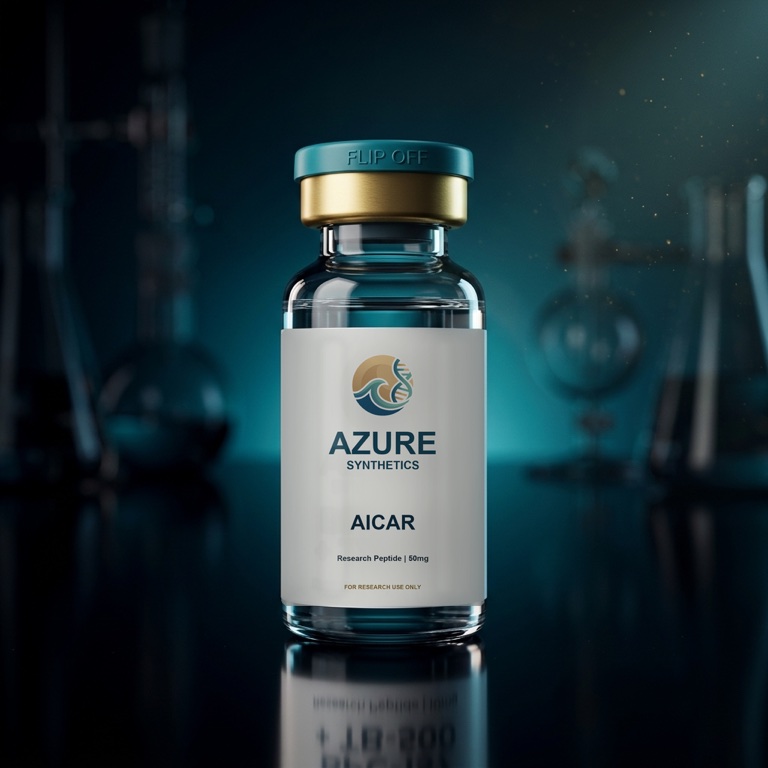
Metabolic research
AICAR
Lyophilized metabolic research compound
AICAR is an AMPK-pathway research compound used as a reference in cellular energy-sensing, glucose uptake, lipid metabolism, and exercise-mimetic literature.
Support can confirm any currently available COAs or batch documentation for this product.
Request available documentsConfirm an optional email signup to receive a single-use 10% welcome code.
Get catalog updatesFor laboratory research use only. Not for human or veterinary use. Not intended to diagnose, treat, cure, mitigate, or prevent disease.
Mantener sellado, frío, seco y protegido de los cambios de calor. Confirme el almacenamiento específico del producto a su llegada.
Empaquetado para estabilidad en tránsito con soporte de pedidos disponible para rutas en climas cálidos.
Batch-linked certificate support is available through the documentation desk.
Contexto de investigación
Perfil de investigación de AICAR
AICAR is an adenosine analog used as a laboratory reference in cellular energy-sensing research. Inside cells it can be converted to ZMP, an AMP-like metabolite associated with activation of AMP-activated protein kinase and other AMP-sensitive processes. Researchers use AICAR in cell and animal models to examine glucose transport, fatty-acid oxidation, mitochondrial signaling, gene expression, and exercise-mimetic hypotheses. It is not a peptide, and its experimental behavior depends strongly on cell type, concentration, exposure time, and metabolic context. AICAR is generally selected when a study requires a direct AMPK-adjacent tool compound rather than an incretin or receptor-agonist peptide.
Molecular class
Small-molecule AMP mimetic
Sequence / composition
5-Aminoimidazole-4-carboxamide ribonucleotide; a purine-nucleoside analog rather than an amino-acid peptide.
Research design note
Intracellular phosphorylation to ZMP is central to its use as an energy-sensing pathway tool compound.
Mecanismo propuesto
An adenosine analog taken up by cells and phosphorylated to ZMP, an AMP mimetic. ZMP can activate AMPK and influence other AMP-sensitive enzymes, shifting signaling toward energy conservation, glucose uptake, fatty-acid oxidation, and mitochondrial adaptation.
Efectos reportados en estudios
- Cell studies report AMPK phosphorylation, increased glucose transport, altered lipid metabolism, and changes in mitochondrial and metabolic gene expression.
- Animal studies reported increased oxidative capacity and endurance-like effects in selected skeletal-muscle models.
- AICAR is not perfectly AMPK specific; ZMP affects additional nucleotide-sensitive pathways and can produce model-dependent effects.
Criterios de investigación comunes
AMPK phosphorylation, ACC phosphorylation, glucose uptake, fatty-acid oxidation, mitochondrial gene expression, oxygen consumption, muscle-fiber markers, and endurance performance.
Evidencia y limitaciones
The strongest evidence is mechanistic and preclinical. AICAR is a pathway tool compound, not a selective peptide receptor ligand.
External reading
Literature for context—not product proof.
Third-party sources describe their own research materials and methods. They do not validate a specific Azure catalog batch.
Support and documentation
Questions about this product?
Where can I find product documentation?
Contact support with the product name and any relevant order or batch reference to request available documents.
How can I compare pack options?
Where multiple pack sizes are available, Azure shows the price per listed vial so you can compare catalog value directly.