
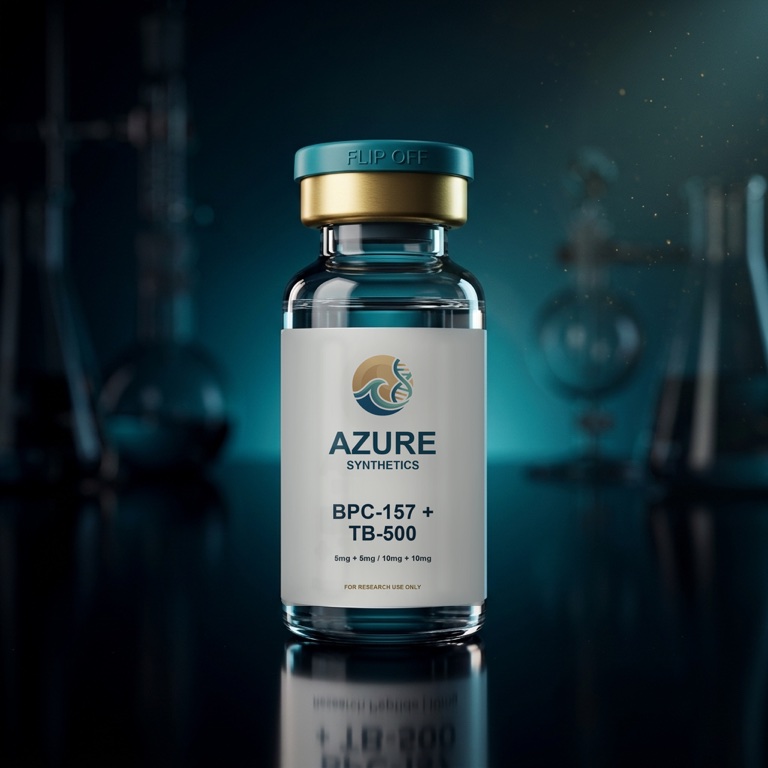
Blend research
BPC-157 + TB-500 Blend
Lyophilized multi-compound laboratory research material
BPC-157 + TB-500 Blend pairs two recovery-category research peptides often compared across repair-pathway, angiogenesis, matrix, and cell-migration literature.
Support can confirm any currently available COAs or batch documentation for this product.
Request available documentsConfirm an optional email signup to receive a single-use 10% welcome code.
Get catalog updatesFor laboratory research use only. Not for human or veterinary use. Not intended to diagnose, treat, cure, mitigate, or prevent disease.
Keep sealed, cold, dry, and protected from heat swings. Confirm product-specific storage on arrival.
Packed for transit stability with order support available for warm-weather routes.
Batch-linked certificate support is available through the documentation desk.
연구 맥락
BPC-157 + TB-500 Blend 연구 프로필
This blend combines BPC-157 and TB-500 in one research format. The two components are discussed in different but partly overlapping preclinical fields: BPC-157 in gastrointestinal, vascular, tendon, and tissue-stress models, and TB-500 in thymosin beta-4-related actin, cell-migration, angiogenesis, and remodeling research. A combined format may simplify projects designed to observe both components under one protocol, but it also makes attribution more difficult because an observed result cannot automatically be assigned to one ingredient. Component-level publications do not establish synergy, stability, or performance of the blend. Researchers should confirm component amounts, identity, storage, and available batch documentation before selection.
Molecular class
Two-component peptide blend
Sequence / composition
A combined format containing BPC-157 and a TB-500-labelled component; it has no single amino-acid sequence.
Research design note
Use single-component and blend controls because component literature does not establish blend behavior or synergy.
제안된 기전
A combined format intended to place BPC-157-associated nitric-oxide, angiogenesis, and fibroblast hypotheses alongside thymosin beta-4-associated actin, migration, and remodeling pathways. A specific blend mechanism or pharmacologic synergy has not been established.
연구에서 보고된 효과
- BPC-157 animal studies report selected repair and gastrointestinal effects, while thymosin beta-4 studies report cell-migration and wound-model effects.
- There is not an adequate independent evidence base demonstrating that the combined product produces additive or synergistic effects.
- A blend complicates attribution because a measured effect cannot be assigned to one component without appropriate single-component controls.
일반적인 연구 평가변수
Component identity, individual and combined controls, wound and tissue histology, migration, angiogenesis, collagen organization, cytokines, nitric-oxide markers, and blend stability.
근거와 한계
Evidence is component based and predominantly preclinical. Blend-specific efficacy, interactions, stability, and human safety are not established.
External reading
Literature for context—not product proof.
Third-party sources describe their own research materials and methods. They do not validate a specific Azure catalog batch.
Support and documentation
Questions about this product?
Where can I find product documentation?
Contact support with the product name and any relevant order or batch reference to request available documents.
How can I compare pack options?
Where multiple pack sizes are available, Azure shows the price per listed vial so you can compare catalog value directly.