
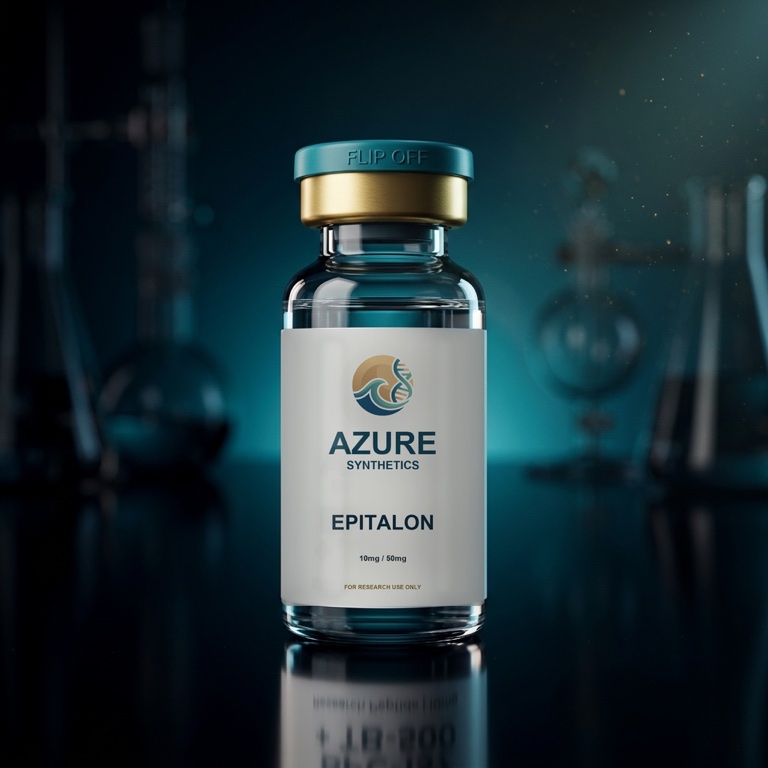
Cellular-biology research
Epitalon
Lyophilized mitochondrial and cellular-signaling research material
Epitalon is a pineal tetrapeptide research compound often discussed in telomere, circadian, and cellular-aging literature.
Support can confirm any currently available COAs or batch documentation for this product.
Request available documentsConfirm an optional email signup to receive a single-use 10% welcome code.
Get catalog updatesPour la recherche en laboratoire uniquement. Pas pour un usage humain ou vétérinaire. Non destiné à diagnostiquer, traiter, guérir, atténuer ou prévenir une maladie.
Conserver scellé, froid, sec et protégé des variations de chaleur. Confirmez le stockage spécifique au produit à l'arrivée.
Emballé pour la stabilité du transit avec une assistance aux commandes disponible pour les itinéraires par temps chaud.
Batch-linked certificate support is available through the documentation desk.
Contexte de recherche
Profil de recherche Epitalon
Epitalon is a synthetic tetrapeptide associated with pineal-peptide and cellular-aging research. Published discussions include telomerase activity, telomere-related markers, circadian and pineal signaling, oxidative-stress responses, gene expression, and lifespan observations in experimental models. The evidence base is smaller, older, and more heterogeneous than the literature for many established receptor peptides, with limited independent human validation. Epitalon is therefore best suited to exploratory laboratory work where the endpoints, controls, and source literature are reviewed carefully. It should not be selected on the assumption that telomere or longevity findings in one model establish an anti-aging outcome in people.
Molecular class
Four-residue synthetic tetrapeptide
Sequence / composition
- A
- E
- D
- G
Defined amino-acid chain, shown in standard one-letter notation.
Research design note
Its very short sequence makes degradation, assay concentration, and controls particularly relevant to interpretation.
Mécanisme proposé
A synthetic Ala-Glu-Asp-Gly tetrapeptide associated with pineal-peptide research. Proposed mechanisms include changes in gene expression, telomerase activity, telomere maintenance, oxidative signaling, and circadian or pineal regulatory pathways.
Effets rapportés dans les études
- Selected cell studies report telomerase activation, telomere-related changes, and altered gene-expression or oxidative-stress markers.
- Rodent and older regional studies report lifespan, circadian, or age-associated observations under specific conditions.
- Independent replication and modern controlled human evidence are limited, and anti-aging effects are not established.
Critères de recherche courants
Telomerase activity, telomere length, gene expression, oxidative-stress markers, melatonin and circadian measures, cell lifespan, organism lifespan, and replication across laboratories.
Preuves et limites
Evidence is limited, heterogeneous, and largely preclinical or based on older regional literature. Mechanism and human outcomes remain uncertain.
External reading
Literature for context—not product proof.
Third-party sources describe their own research materials and methods. They do not validate a specific Azure catalog batch.
Support and documentation
Questions about this product?
Where can I find product documentation?
Contact support with the product name and any relevant order or batch reference to request available documents.
How can I compare pack options?
Where multiple pack sizes are available, Azure shows the price per listed vial so you can compare catalog value directly.