
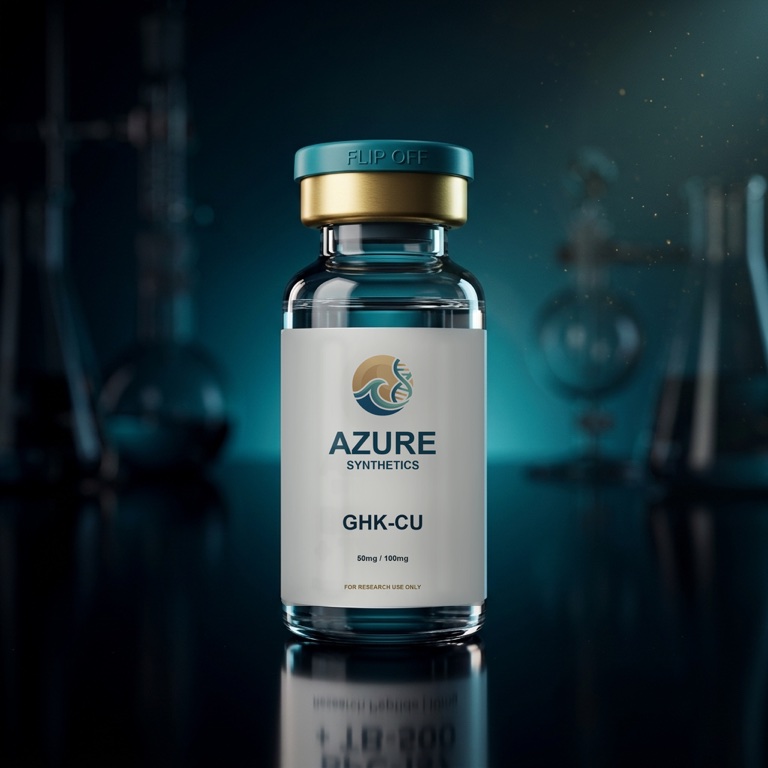
Dermal and melanocortin research
GHK-Cu
Lyophilized dermal or melanocortin research peptide
GHK-Cu is a copper tripeptide research compound connected to dermal matrix, collagen, extracellular-matrix, and wound-model literature.
This product has an available COA with reported batch details and test results.
Open available COAConfirm an optional email signup to receive a single-use 10% welcome code.
Get catalog updatesAlleen voor laboratoriumonderzoek. Niet voor menselijk of diergeneeskundig gebruik. Niet bedoeld voor het diagnosticeren, behandelen, genezen, verzachten of voorkomen van ziekten.
Afgesloten, koud, droog en beschermd tegen hitteschommelingen bewaren. Bevestig productspecifieke opslag bij aankomst.
Verpakt voor stabiliteit tijdens het transport, met bestelondersteuning beschikbaar voor routes bij warm weer.
Batch-linked certificate support is available through the documentation desk.
Onderzoekscontext
GHK-Cu onderzoeksprofiel
GHK-Cu is the copper complex of the naturally occurring tripeptide glycyl-L-histidyl-L-lysine. It is studied in dermal, extracellular-matrix, wound, and cell-signaling models involving copper transport, collagen and elastin markers, fibroblast behavior, tissue remodeling, and gene-expression changes. Experimental outcomes can depend on copper loading, formulation, concentration, cell type, and delivery system, so literature on a finished topical formulation is not automatically comparable with isolated research material. GHK-Cu is most useful when a project specifically requires a copper-binding peptide reference rather than a general repair peptide. Product identity, copper complex status, amount, and batch documentation should be reviewed together.
Molecular class
Copper-binding tripeptide complex
Sequence / composition
- G
- H
- K
Defined amino-acid chain, shown in standard one-letter notation.
Research design note
Copper coordination, oxidation state, free copper, and formulation strongly influence the experimental system.
Voorgesteld mechanisme
GHK binds copper(II), forming a copper-peptide complex proposed to influence copper delivery, gene expression, extracellular-matrix remodeling, antioxidant enzymes, inflammatory signaling, and activity of fibroblasts and other repair-associated cells.
In studies gerapporteerde effecten
- Cell and animal studies reported increased collagen, elastin, glycosaminoglycan, fibroblast activity, angiogenesis, and wound closure in selected models.
- Topical formulation studies reported changes in skin density, appearance, or fine-line measurements under formulation-specific conditions.
- Effects depend on copper complexation, concentration, formulation, penetration, cell type, and the biological model.
Veelgebruikte onderzoekseindpunten
Copper binding, collagen and elastin synthesis, matrix metalloproteinases, fibroblast migration, antioxidant markers, inflammatory cytokines, wound closure, skin imaging, and histology.
Bewijs en beperkingen
Mechanistic and preclinical evidence is substantial, with some formulation-specific human cosmetic data. Results from finished formulations do not establish effects of isolated powder.
External reading
Literature for context—not product proof.
Third-party sources describe their own research materials and methods. They do not validate a specific Azure catalog batch.
Support and documentation
Questions about this product?
Where can I find product documentation?
Open the direct COA link on this page. For other batch documents, contact support with the product name and any relevant order or batch reference.
How can I compare pack options?
Where multiple pack sizes are available, Azure shows the price per listed vial so you can compare catalog value directly.