
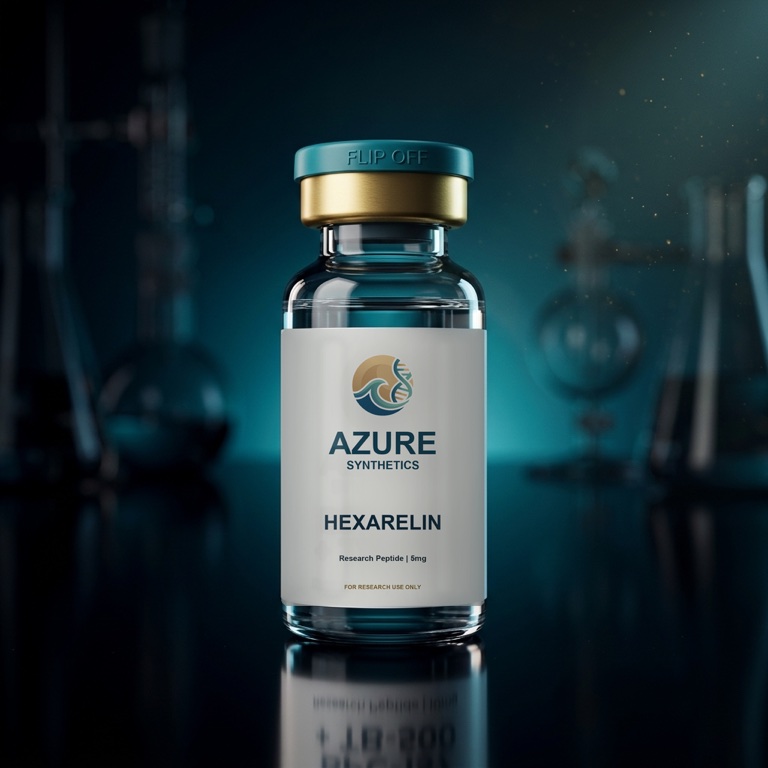
GH-axis research
Hexarelin
Peptide lyophilisé de recherche de signalisation endocrinienne pour l'examen des systèmes
Hexarelin is a synthetic GH secretagogue research peptide studied in endocrine and cardiometabolic signaling models.
Support can confirm any currently available COAs or batch documentation for this product.
Request available documentsConfirm an optional email signup to receive a single-use 10% welcome code.
Get catalog updatesPour la recherche en laboratoire uniquement. Pas pour un usage humain ou vétérinaire. Non destiné à diagnostiquer, traiter, guérir, atténuer ou prévenir une maladie.
Conserver scellé, froid, sec et protégé des variations de chaleur. Confirmez le stockage spécifique au produit à l'arrivée.
Emballé pour la stabilité du transit avec une assistance aux commandes disponible pour les itinéraires par temps chaud.
Batch-linked certificate support is available through the documentation desk.
Contexte de recherche
Profil de recherche Hexarelin
Hexarelin is a synthetic hexapeptide growth hormone secretagogue studied at the ghrelin receptor. Research includes GH-release response, receptor potency, endocrine markers, desensitization, and experimental cardiac or metabolic signaling observations. It is often compared with GHRP-2, GHRP-6, and ipamorelin to examine differences in potency and selectivity, while GHRH analogs such as sermorelin and CJC-1295 provide a separate receptor pathway for comparison. Hexarelin is most appropriate when a study specifically needs this GHS-R ligand rather than a general GH-axis material. Much of the broader mechanistic evidence is preclinical or early-stage and should remain tied to its original model.
Molecular class
Six-residue GH secretagogue
Sequence / composition
His-D-2-methyl-Trp-Ala-Trp-D-Phe-Lys-NH2; a modified hexapeptide with non-native stereochemistry.
Research design note
Sequence modifications are central to its potency and mean it should not be treated as a native ghrelin fragment.
Mécanisme proposé
A potent synthetic GHS-R1a agonist that stimulates GH release through pituitary and hypothalamic pathways. Additional cardiac and cytoprotective mechanisms have been proposed in preclinical studies, some potentially independent of GH.
Effets rapportés dans les études
- Human pharmacology studies reported strong acute GH release and endocrine responses after hexarelin exposure.
- Animal and cell studies reported changes in cardiac function, survival signaling, fibrosis, and tissue-injury markers.
- Repeated exposure can cause desensitization, and cardiac findings remain largely preclinical and mechanism dependent.
Critères de recherche courants
GHS-R potency, GH, ACTH, cortisol, prolactin, receptor desensitization, cardiac contractility, fibrosis, apoptosis, inflammatory markers, and pharmacokinetics.
Preuves et limites
Human evidence primarily addresses acute endocrine pharmacology; proposed cardiac effects are largely preclinical and not established as human outcomes.
External reading
Literature for context—not product proof.
Third-party sources describe their own research materials and methods. They do not validate a specific Azure catalog batch.
Support and documentation
Questions about this product?
Where can I find product documentation?
Contact support with the product name and any relevant order or batch reference to request available documents.
How can I compare pack options?
Where multiple pack sizes are available, Azure shows the price per listed vial so you can compare catalog value directly.