
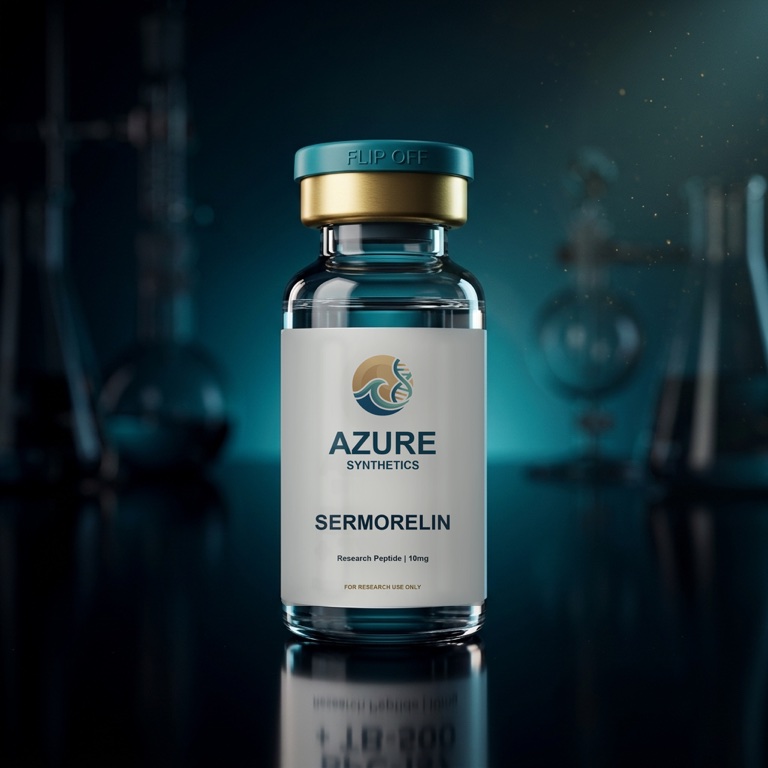
GH-axis research
Sermorelin
Peptídeo liofilizado de pesquisa de sinalização endócrina para revisão de sistemas
Sermorelin is a GHRH 1-29 analog studied as a classic pituitary GH-axis research reference.
Support can confirm any currently available COAs or batch documentation for this product.
Request available documentsConfirm an optional email signup to receive a single-use 10% welcome code.
Get catalog updatesSomente para uso em pesquisa laboratorial. Não é para uso humano ou veterinário. Não se destina a diagnosticar, tratar, curar, mitigar ou prevenir doenças.
Mantenha selado, frio, seco e protegido de oscilações de calor. Confirme o armazenamento específico do produto na chegada.
Embalado para estabilidade de trânsito com suporte para pedidos disponível para rotas em clima quente.
Batch-linked certificate support is available through the documentation desk.
Contexto de pesquisa
Perfil de pesquisa de Sermorelin
Sermorelin is a 29-amino-acid analog corresponding to the active amino-terminal region of growth hormone-releasing hormone. It is used as a classic reference for pituitary GHRH-receptor signaling, stimulated GH release, endocrine responsiveness, and downstream IGF-1 measurements. Compared with CJC-1295 with DAC, sermorelin represents a shorter GHRH framework without the same half-life-extension design. Compared with ipamorelin and GHRP peptides, it acts through a different receptor pathway. Researchers generally select sermorelin when the study calls for a well-established GHRH 1-29 reference or a direct comparison of pituitary signaling across GHRH analogs and ghrelin-receptor secretagogues.
Molecular class
44-residue GHRH 1-44 analog
Sequence / composition
A synthetic amino-terminal 44-residue segment corresponding to the receptor-active region of human GHRH.
Research design note
It is a direct GHRH-receptor reference, unlike GH secretagogues that act through GHS-R.
Mecanismo proposto
A synthetic GHRH(1-29) peptide that activates the pituitary GHRH receptor, increases cyclic AMP, and stimulates endogenous growth-hormone release from responsive somatotroph cells.
Efeitos relatados em estudos
- Human diagnostic and pharmacology studies reported acute GH release and used the response to evaluate pituitary reserve.
- Downstream changes can include transient increases in GH and IGF-1-related markers when repeated exposure is studied.
- Responses vary with age, pituitary function, endogenous somatostatin tone, timing, and prior exposure.
Desfechos comuns de pesquisa
GHRH receptor signaling, cyclic AMP, peak and integrated GH, IGF-1, pituitary responsiveness, age-related response, pharmacokinetics, and comparison with longer-acting GHRH analogs.
Evidências e limitações
The GHRH stimulation mechanism is well characterized, including historical human diagnostic use. This does not establish therapeutic equivalence of a catalog product.
External reading
Literature for context—not product proof.
Third-party sources describe their own research materials and methods. They do not validate a specific Azure catalog batch.
Support and documentation
Questions about this product?
Where can I find product documentation?
Contact support with the product name and any relevant order or batch reference to request available documents.
How can I compare pack options?
Where multiple pack sizes are available, Azure shows the price per listed vial so you can compare catalog value directly.