
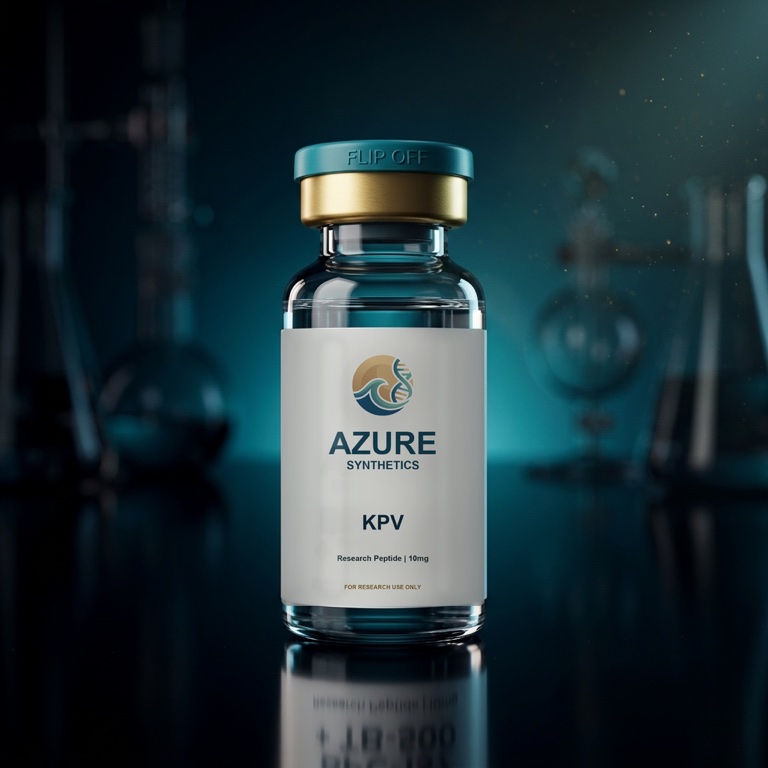
Immune research
KPV
Lyophilized immune-signaling research peptide for pathway review
KPV is an alpha-MSH fragment research peptide studied around epithelial integrity, immune signaling, and inflammatory-pathway models.
Support can confirm any currently available COAs or batch documentation for this product.
Request available documentsConfirm an optional email signup to receive a single-use 10% welcome code.
Get catalog updatesAlleen voor laboratoriumonderzoek. Niet voor menselijk of diergeneeskundig gebruik. Niet bedoeld voor het diagnosticeren, behandelen, genezen, verzachten of voorkomen van ziekten.
Afgesloten, koud, droog en beschermd tegen hitteschommelingen bewaren. Bevestig productspecifieke opslag bij aankomst.
Verpakt voor stabiliteit tijdens het transport, met bestelondersteuning beschikbaar voor routes bij warm weer.
Batch-linked certificate support is available through the documentation desk.
Onderzoekscontext
KPV onderzoeksprofiel
KPV is the tripeptide Lys-Pro-Val, a short fragment derived from the carboxyl end of alpha-melanocyte-stimulating hormone. Preclinical research examines epithelial integrity, cytokine signaling, inflammatory-pathway markers, microbial interactions, and gut or skin model systems. Unlike broader melanocortin analogs, KPV is generally studied for fragment-specific activity and may not reproduce the full receptor profile of alpha-MSH. It is a focused choice for projects comparing short melanocortin-derived peptides in epithelial or immune-signaling experiments. Evidence is primarily laboratory and animal based, and reported pathway effects depend on the model, concentration, formulation, and endpoints used in the original study.
Molecular class
Alpha-MSH-derived tripeptide
Sequence / composition
- K
- P
- V
Defined amino-acid chain, shown in standard one-letter notation.
Research design note
Its short sequence and proposed transporter-dependent cell entry make uptake and stability useful assay controls.
Voorgesteld mechanisme
A Lys-Pro-Val tripeptide derived from the C-terminal region of alpha-MSH. Proposed actions include cell entry through peptide transport systems and suppression of NF-kappaB, MAPK, cytokine, and microbial-response pathways, sometimes independently of classical melanocortin receptors.
In studies gerapporteerde effecten
- Cell studies reported reduced activation of inflammatory transcription pathways and lower production of selected cytokines.
- Animal and epithelial models reported reduced inflammation or tissue injury in selected gut, skin, and infection-related experiments.
- Mechanism, transport, and potency vary by model, and controlled human evidence is not established.
Veelgebruikte onderzoekseindpunten
NF-kappaB and MAPK activation, cytokines such as TNF-alpha and IL-6, epithelial permeability, histology, microbial growth, peptide transport, and tissue-injury scores.
Bewijs en beperkingen
Evidence is primarily cell and animal based. Human pharmacokinetics, efficacy, and safety remain insufficiently characterized.
External reading
Literature for context—not product proof.
Third-party sources describe their own research materials and methods. They do not validate a specific Azure catalog batch.
Support and documentation
Questions about this product?
Where can I find product documentation?
Contact support with the product name and any relevant order or batch reference to request available documents.
How can I compare pack options?
Where multiple pack sizes are available, Azure shows the price per listed vial so you can compare catalog value directly.