
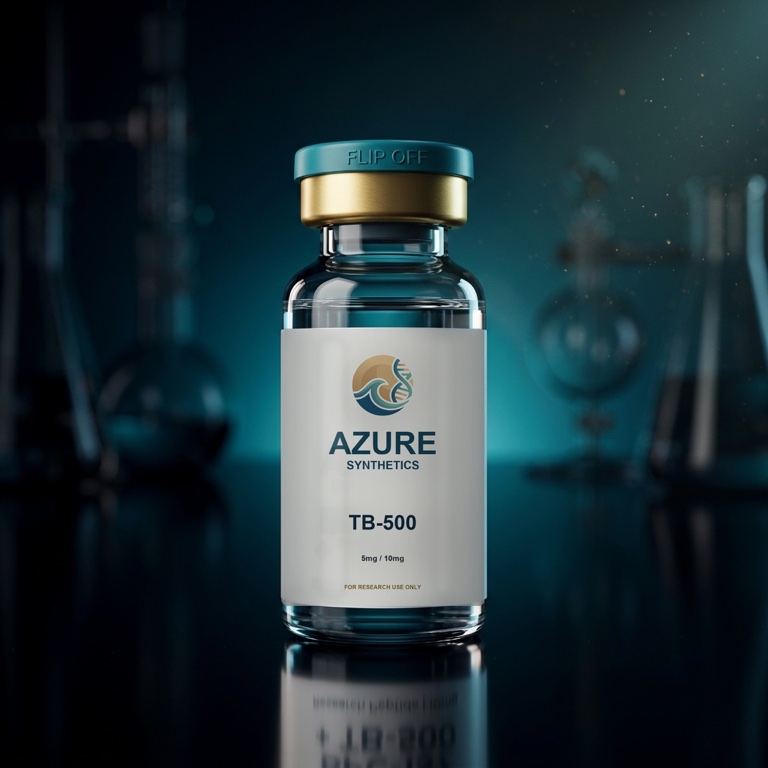
Tissue-signaling research
TB-500
Lyophilized tissue-signaling peptide for preclinical pathway research
TB-500 is a thymosin beta-4 fragment research peptide connected to actin regulation, cell migration, tissue-stress, and wound-model literature.
This product has an available COA with reported batch details and test results.
Open available COAConfirm an optional email signup to receive a single-use 10% welcome code.
Get catalog updatesNur für Laborforschungszwecke. Nicht für den menschlichen oder veterinärmedizinischen Gebrauch bestimmt. Nicht zur Diagnose, Behandlung, Heilung, Linderung oder Vorbeugung von Krankheiten bestimmt.
Verschlossen, kalt, trocken und vor Hitzeschwankungen geschützt aufbewahren. Bestätigen Sie die produktspezifische Lagerung bei der Ankunft.
Verpackt für Transportstabilität mit Bestellunterstützung für Routen bei warmem Wetter.
Batch-linked certificate support is available through the documentation desk.
Forschungskontext
TB-500 Forschungsprofil
TB-500 is a synthetic research peptide commonly discussed in relation to thymosin beta-4 biology. Experimental work in this area examines actin binding and sequestration, cell migration, angiogenesis, inflammatory signaling, tissue remodeling, and wound-model endpoints. Researchers should distinguish a marketed TB-500 fragment from full-length thymosin beta-4 because sequence, identity, and experimental behavior may not be interchangeable across publications. This material is generally selected for cell-motility and tissue-stress studies or for comparison with other repair-pathway peptides. Most relevant evidence is preclinical, and literature on thymosin beta-4 cannot automatically be treated as evidence for every fragment, formulation, blend, or catalog lot.
Molecular class
Thymosin beta-4-related peptide material
Sequence / composition
Commercial TB-500 naming does not consistently specify one sequence; related thymosin beta-4 literature includes the actin-binding LKKTET region.
Research design note
Confirm the exact sequence and batch identity before transferring results from full-length thymosin beta-4 or another fragment.
Vorgeschlagener Mechanismus
Usually discussed through thymosin beta-4 biology, particularly binding of monomeric actin through the LKKTET region. Proposed downstream effects include altered cytoskeletal dynamics, cell migration, angiogenesis, inflammatory signaling, and extracellular-matrix remodeling.
In Studien berichtete Effekte
- Full-length thymosin beta-4 studies reported increased cell migration, angiogenesis, epithelial repair, and wound closure in selected models.
- Animal studies reported effects on cardiac, corneal, dermal, and musculoskeletal injury markers under specific conditions.
- Commercial TB-500 may not be molecularly identical to full-length thymosin beta-4, so effects cannot automatically be transferred between materials.
Häufige Forschungsendpunkte
Actin binding, cell migration, angiogenesis, wound closure, collagen and matrix organization, inflammatory markers, tissue histology, and sequence identity.
Evidenz und Grenzen
Most evidence concerns thymosin beta-4 or preclinical fragments. Product sequence and identity are essential because direct human TB-500 evidence is limited.
External reading
Literature for context—not product proof.
Third-party sources describe their own research materials and methods. They do not validate a specific Azure catalog batch.
Support and documentation
Questions about this product?
Where can I find product documentation?
Open the direct COA link on this page. For other batch documents, contact support with the product name and any relevant order or batch reference.
How can I compare pack options?
Where multiple pack sizes are available, Azure shows the price per listed vial so you can compare catalog value directly.