
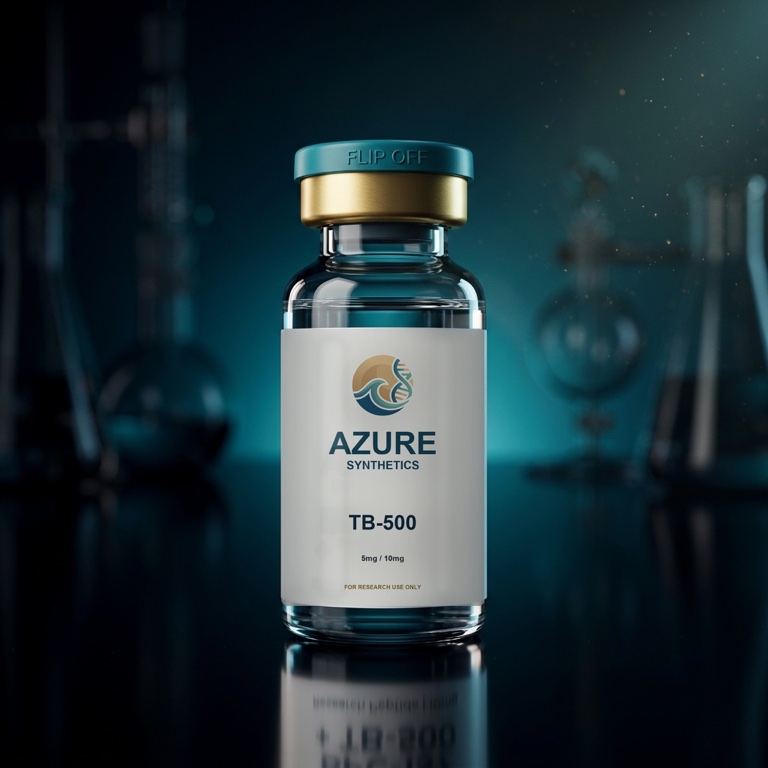
Tissue-signaling research
TB-500
Lyophilized tissue-signaling peptide for preclinical pathway research
TB-500 is a thymosin beta-4 fragment research peptide connected to actin regulation, cell migration, tissue-stress, and wound-model literature.
This product has an available COA with reported batch details and test results.
Open available COAConfirm an optional email signup to receive a single-use 10% welcome code.
Get catalog updatesFor laboratory research use only. Not for human or veterinary use. Not intended to diagnose, treat, cure, mitigate, or prevent disease.
Mantener sellado, frío, seco y protegido de los cambios de calor. Confirme el almacenamiento específico del producto a su llegada.
Empaquetado para estabilidad en tránsito con soporte de pedidos disponible para rutas en climas cálidos.
Batch-linked certificate support is available through the documentation desk.
Contexto de investigación
Perfil de investigación de TB-500
TB-500 is a synthetic research peptide commonly discussed in relation to thymosin beta-4 biology. Experimental work in this area examines actin binding and sequestration, cell migration, angiogenesis, inflammatory signaling, tissue remodeling, and wound-model endpoints. Researchers should distinguish a marketed TB-500 fragment from full-length thymosin beta-4 because sequence, identity, and experimental behavior may not be interchangeable across publications. This material is generally selected for cell-motility and tissue-stress studies or for comparison with other repair-pathway peptides. Most relevant evidence is preclinical, and literature on thymosin beta-4 cannot automatically be treated as evidence for every fragment, formulation, blend, or catalog lot.
Molecular class
Thymosin beta-4-related peptide material
Sequence / composition
Commercial TB-500 naming does not consistently specify one sequence; related thymosin beta-4 literature includes the actin-binding LKKTET region.
Research design note
Confirm the exact sequence and batch identity before transferring results from full-length thymosin beta-4 or another fragment.
Mecanismo propuesto
Usually discussed through thymosin beta-4 biology, particularly binding of monomeric actin through the LKKTET region. Proposed downstream effects include altered cytoskeletal dynamics, cell migration, angiogenesis, inflammatory signaling, and extracellular-matrix remodeling.
Efectos reportados en estudios
- Full-length thymosin beta-4 studies reported increased cell migration, angiogenesis, epithelial repair, and wound closure in selected models.
- Animal studies reported effects on cardiac, corneal, dermal, and musculoskeletal injury markers under specific conditions.
- Commercial TB-500 may not be molecularly identical to full-length thymosin beta-4, so effects cannot automatically be transferred between materials.
Criterios de investigación comunes
Actin binding, cell migration, angiogenesis, wound closure, collagen and matrix organization, inflammatory markers, tissue histology, and sequence identity.
Evidencia y limitaciones
Most evidence concerns thymosin beta-4 or preclinical fragments. Product sequence and identity are essential because direct human TB-500 evidence is limited.
External reading
Literature for context—not product proof.
Third-party sources describe their own research materials and methods. They do not validate a specific Azure catalog batch.
Support and documentation
Questions about this product?
Where can I find product documentation?
Open the direct COA link on this page. For other batch documents, contact support with the product name and any relevant order or batch reference.
How can I compare pack options?
Where multiple pack sizes are available, Azure shows the price per listed vial so you can compare catalog value directly.